
Profile / Background
North Lanarkshire Council secured Climate Ready Clyde funding to improve flood resilience across the Allanton catchment through the delivery of natural flood management (NFM) measures. Works were focused within Kingshill Local Nature Reserve and the operational Allanton Minewater Treatment Works, with additional feasibility modelling undertaken for a potential wetland scheme at Redmire Park.
The project aimed to reduce flood risk using nature-based approaches while delivering wider environmental benefits, demonstrating how flood management and habitat enhancement can be achieved together within a multifunctional landscape.
Climate Risks and Impacts
The Allanton catchment is vulnerable to both surface water and river flooding, with rainfall runoff moving rapidly through a network of drainage ditches towards Allanton village.
Historic alterations to the drainage system had reduced natural water storage capacity, while limited vegetation cover restricted rainfall interception and soil stability. The movement of sediment associated with ochre-rich minewater created additional challenges. With climate change expected to increase the intensity and frequency of heavy rainfall events, there was a need to slow water movement through the catchment and restore more natural hydrological processes.
Adaptation Actions Taken
The project delivered a range of natural flood management interventions designed to slow, store and manage water throughout the catchment.
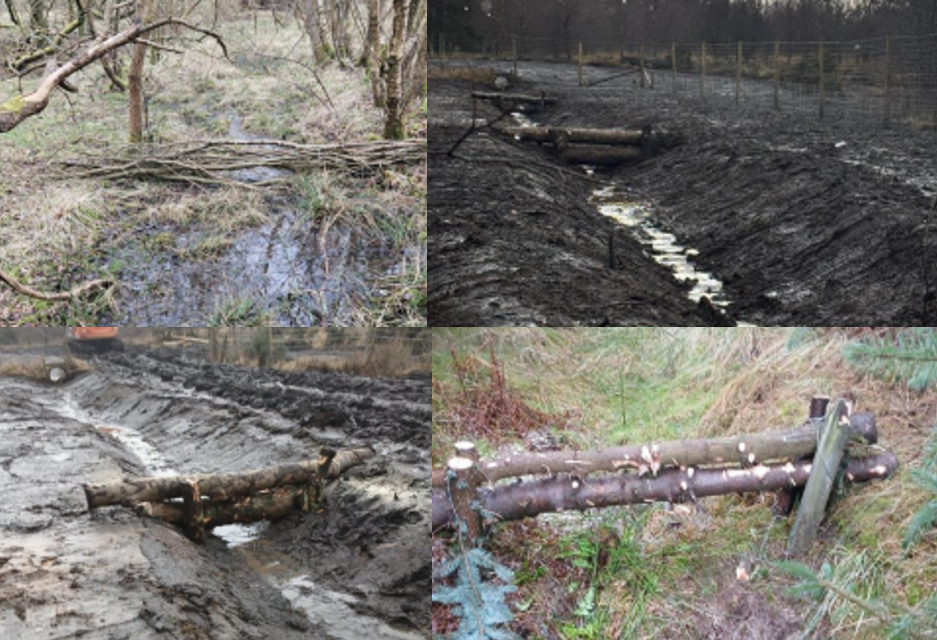
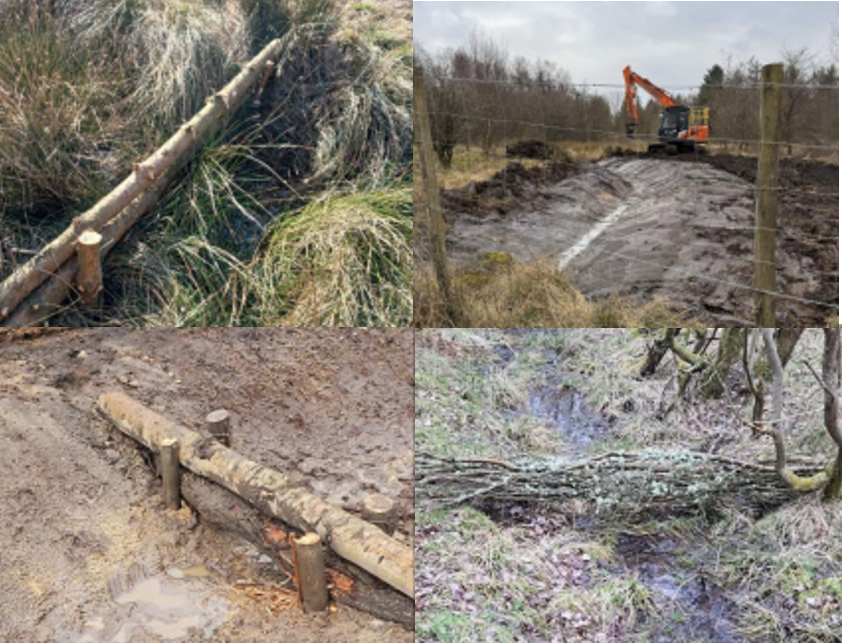
Within Kingshill Local Nature Reserve, 18 leaky dams were installed to reduce flow speeds within drainage ditches, alongside approximately 250 metres of clay bunds to intercept overland runoff. Brash bundles and a large overland leaky barrier were also constructed to slow flows and trap sediment, while around 500 metres of ditch clearance improved the effectiveness of existing drainage features.
To enhance resilience over the longer term, approximately 1,020 native trees were planted across the site, providing increased rainfall interception, improved soil stability and valuable habitat benefits.
Alongside the physical works, hydrological modelling and concept design work were undertaken to assess the feasibility of creating a future wetland attenuation scheme at Redmire Park.
Support and Collaboration
The project was led by North Lanarkshire Council’s Water Management Team and delivered with support from Climate Ready Clyde, Enviroclean, the Council’s Greenspace and Country Parks Team, the arboriculture team, and local community representatives.
Close collaboration between technical specialists, contractors and environmental teams helped ensure flood management objectives were successfully integrated with biodiversity and landscape enhancements. Community engagement activities also helped raise awareness of the project and its benefits.
Outcomes / Benefits
The project has strengthened the catchment’s ability to manage heavy rainfall by slowing water movement, increasing temporary storage and encouraging greater infiltration into the ground.
Early observations indicate that water is being retained effectively behind the installed features, helping to reduce flow velocities and restore more natural drainage processes. The measures are also reducing sediment movement and improving the overall condition of the reserve.
Beyond flood resilience, the project has created significant environmental benefits. New tree planting and habitat improvements have enhanced biodiversity and ecological connectivity, while the reserve itself has become a more attractive and resilient greenspace for visitors and local communities.
The Redmire Park modelling has also created an evidence base for future investment in larger-scale wetland attenuation measures downstream.
Reflections
One of the project’s greatest strengths was the close partnership working between council teams and contractors. This collaborative approach allowed designs to be refined during delivery and ensured interventions responded to site conditions on the ground.
The use of locally sourced natural materials proved both cost-effective and environmentally beneficial, while integrating ecological enhancement with flood management helped maximise the value of the investment.
Challenges included difficult access conditions caused by soft ground, balancing engineering requirements with ecological sensitivities, and limited baseline hydrological data. These were addressed through flexible construction methods, low-impact installation techniques and adjustments to intervention locations as works progressed.
Future projects would benefit from collecting longer-term flow data before design work begins and introducing monitoring equipment earlier to provide a stronger evidence base for measuring outcomes.
Next Steps / Future Plans
Monitoring of the natural flood management features will continue to assess their long-term performance and inform future investment decisions. The new assets will also be incorporated into council GIS and asset management systems.
The next stage of work will focus on developing the Redmire Park wetland proposal, with the potential for a future delivery phase that provides additional flood storage and attenuation. There is also scope to expand natural flood management measures across the wider catchment, building on the success of the current project.
Learning / Replication Tips
This project highlights the value of working with natural processes to manage flood risk. Small-scale interventions, when implemented across a catchment, can collectively make a meaningful contribution to flood resilience while delivering wider benefits for biodiversity, landscape quality and community wellbeing.
Key lessons include the importance of cross-team collaboration, designing flexibly to accommodate site conditions, and gathering robust hydrological data early in the project lifecycle. Integrating ecological expertise from the outset can also help maximise environmental outcomes alongside climate adaptation objectives.