
 Profile / Background
The Raingarden Parklet Pilot is a proposed green infrastructure project within the Glasgow City Innovation District. It seeks to transform the footprint of a single car parking space into a multifunctional public asset that manages surface water, enhances the streetscape and supports climate adaptation.
Based on Sustainable Urban Drainage Systems (SuDS) principles, the parklet would act as a highly visible demonstration of how small pieces of urban space can contribute to climate resilience. The project also supports the University of Strathclyde’s sustainability ambitions by helping to address flood risks associated with increasingly intense rainfall while creating opportunities for education, community engagement and social impact.
Raingarden Parklets respond to multiple urban challenges:
· Climate resilience – capturing stormwater during heavy downpours, easing pressure on drainage, and reducing flood risk, contributing to “sponge city” principles
· Urban wellbeing – creating resting places, enhancing streetscapes, and providing accessible green space
· Durability and sustainability – constructed from recycled and circular materials, overcoming the short lifespan of timber street furniture
· Visibility and engagement – making climate adaptation solutions visible, understandable, and valued in public spaces.
Beyond their core function, the Raingarden Parklets act as innovation platforms, capable of integrating air quality sensors, bike parking, renewable energy features, street art, and community uses.
Climate Risks and Impacts
The project responds to the growing challenge of heavier and more frequent rainfall events in urban areas. Increasing pressure on drainage networks can lead to surface water flooding, disruption to city infrastructure and rising costs associated with flood management.
As a dense urban environment, Glasgow City Centre faces challenges in managing rainfall where hard surfaces limit natural infiltration. The pilot was conceived as a practical way to demonstrate how greener streets can help reduce runoff, improve resilience and contribute to wider climate adaptation goals.
Adaptation Actions Taken
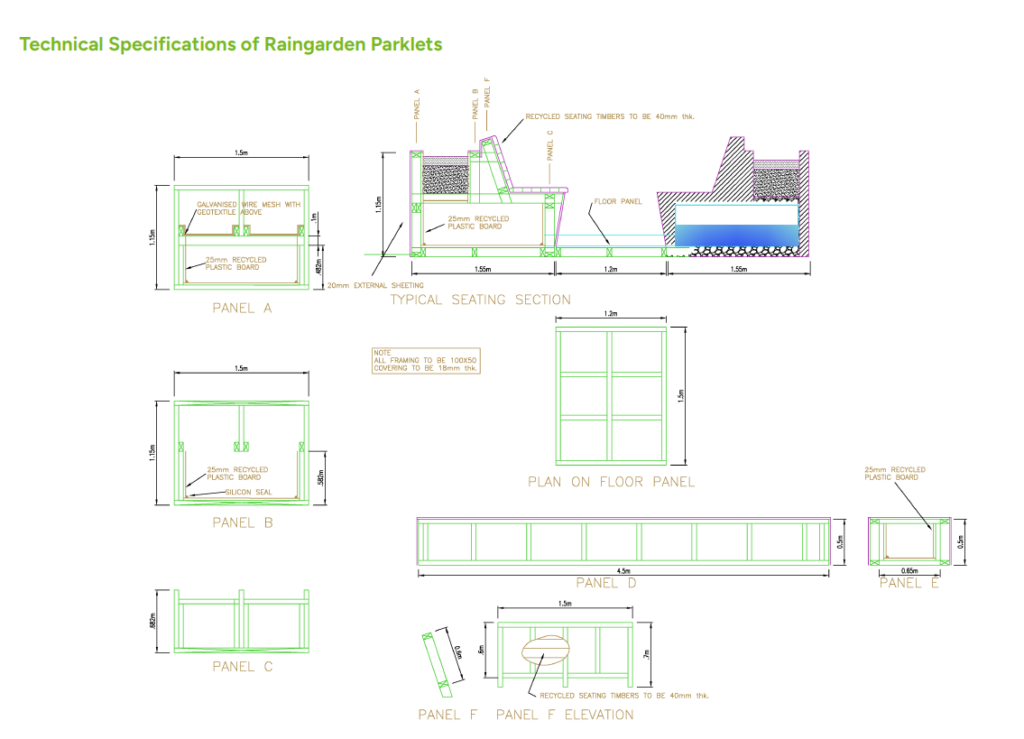
The proposed intervention centres on a modular Raingarden Parklet designed to capture, absorb and filter rainwater before it enters conventional drainage systems.
Using SuDS principles, the parklet slows and stores stormwater, helping to reduce pressure on drainage infrastructure and lower local flood risk. At the same time, it creates an attractive public space that strengthens connections between university-owned land and the surrounding city.
The project has also been designed as an educational resource, offering real-world examples of climate adaptation for students and researchers in disciplines such as sustainability, architecture, engineering and urban design. Its highly visible location would encourage wider public engagement with climate change, resilience and urban transformation.
Support and Collaboration
A distinctive feature of the project is its partnership with HMP Barlinnie. The modular parklets are constructed using 100% recycled materials by individuals with lived experience of the justice system who are developing practical green skills.
The initiative brings together climate adaptation, education, skills development and social justice objectives. It creates opportunities for collaboration between universities, community organisations, the justice sector and the emerging green economy.
Outcomes / Benefits
The Raingarden Parklet is intended to deliver a range of environmental, social and educational benefits.
From an adaptation perspective, it would increase local resilience to heavy rainfall by capturing and filtering runoff, reducing pressure on drainage infrastructure and demonstrating the role green infrastructure can play in managing flood risk.
The project would also enhance the public realm, replacing a car parking space with a greener and more welcoming environment. As an educational asset, it provides a practical example of climate adaptation in action, supporting teaching, research and public awareness.
Perhaps most significantly, the project generates wider social value. Profits from the pilot would support the development of a structured green skills pathway, with a longer-term ambition to establish a Green Skills Factory at the future HMP Glasgow and a community-based production hub. By creating routes into employment within the growing green economy, the initiative aims to tackle some of the underlying causes of reoffending while supporting a just transition to a low-carbon future.
 Credit: Alastair Johnstone / Climate Visuals
Reflections
The project demonstrates how a relatively small intervention can deliver multiple benefits when designed with both environmental and social outcomes in mind. Rather than viewing climate adaptation solely as an engineering challenge, the pilot uses green infrastructure to address issues including education, community engagement, skills development and social inclusion.
Its greatest strength lies in combining flood resilience with wider societal benefits, creating an intervention that is visible, practical and replicable across the city.
Next Steps / Future Plans
The pilot is intended to act as a flagship demonstration project and a catalyst for wider deployment of Raingarden Parklets throughout Glasgow.
Future ambitions include expanding the model to additional locations, growing the associated green skills programme and supporting the development of production facilities linked to the new HMP Glasgow. The project also aims to inspire a broader conversation about how urban space can be repurposed to deliver greater value for communities, climate resilience and biodiversity.
Learning / Replication Tips
This concept highlights the potential for small-scale green infrastructure to have a disproportionate impact when environmental, social and educational objectives are considered together.
Key lessons include the value of designing multifunctional interventions, embedding community benefit within climate adaptation projects, and using highly visible locations to raise awareness of climate resilience. The model could be replicated by universities, local authorities and community organisations seeking to address flood risk while delivering wider social and environmental outcomes.